
"Before you deposit at any online interface, understand that poker is governed by strict mathematical rules and positional mechanics, not just luck. Master the hand rankings and betting logic first." - Nisha Rao, Casino and Betting India

Poker is not what most ads make it look like.
When Indian players search for the best casino sites in India or an online poker game, they often run into promotional noise that drowns out the actual facts. We see it constantly: players burning through bankrolls because they misunderstood table positions, skipped the rules, or jumped into no-limit games on day one. During a recent audit of an iGaming platform, we tracked user behaviours that led to fast losses. After introducing a visual table guide, player retention on lower limits improved noticeably (read our full analysis on iGaming). Your first real step? Learn how poker works structurally before risking your budget.
Before you dive into the rules - make sure you have chosen the right platform. At Casino you will find verified poker rooms that support UPI, INR and micro-limits ideal for beginners.
This guide breaks down the core poker rules, essential poker hand rankings, and the structured betting rounds that shape every poker game. It also includes a quick-reference glossary, a legality overview for Indian players and a practical checklist for choosing a safe poker site.
Quick Glossary of Poker Actions
Before reading about betting rounds and strategy, memorise these five fundamental moves. Every decision you make at the table comes down to one of them:
| Action | When it is available | What it means |
|---|---|---|
| Fold | After any bet or raise has been made | You surrender your cards and exit the current hand. You lose any chips already committed. |
| Check | Only when no bet has been made in the current round | You pass the action to the next player without wagering. If everyone checks, the round ends. |
| Bet | When no prior bet exists in the current round | You place the first wager of the round, setting the price for others to continue. |
| Call | After a bet or raise has been made | You match the current highest bet to stay in the hand. |
| Raise | After a bet or call | You increase the current bet by at least the size of the previous bet, forcing opponents to put in more chips. |
These definitions follow the World Series of Poker Official Rules (WSOP, 2024) and the Poker Tournament Directors Association Rules (PTDA, 2024). Keep this table open during your first sessions. It eliminates that panicked feeling when the action lands on you.

What Is Poker and How the Game Works
Poker is a card game where players wager chips on the mathematical strength of their hand, or attempt to bluff opponents into folding so they can win the central pot. The game operates through a strict sequence of betting rounds driven by private hole cards and shared community cards. Recognising poker as a game of incomplete information is the first step toward understanding it properly.
Each participant sits at the table using chips that represent financial value or tournament equity. The basic round logic in a poker game involves receiving initial cards, evaluating shared community cards as they appear, and deciding whether to commit more chips into the pot.
"Texas Hold'em has an almost infinite decision tree, making it the benchmark for studying decision-making under uncertainty." - PokerBench: A Benchmark for LLM Poker Reasoning (2024). arxiv.org/abs/2501.08328
That sounds abstract. In practice, it means no two hands play out the same way.

The Goal of the Game: Win the Pot
The main goal is straightforward: win the pot, which holds all the money or chips wagered during the betting rounds. You can secure this pot either by holding the highest-ranking cards at the final showdown or by placing a bet that forces every other participant to fold.
Players compete for the pot by constantly assessing the expected value of their poker hand against the probable holdings of opponents. Bets matter because they directly control the pot size and apply psychological pressure. A winning hand dictates the result at the end, but strategic betting can end the round early if opponents refuse to match the current wager. The chips serve as a defined mathematical currency for these actions.
"University of Alberta researchers computed a near-perfect strategy for heads-up limit Hold'em that cannot be exploited by more than 0.000986 big blinds per hand." - Bowling, M. et al., "Heads-up Limit Hold'em Poker is Solved," Science (2015). science.org/doi/10.1126/science.1259433

Cards, Dealer and Table Positions
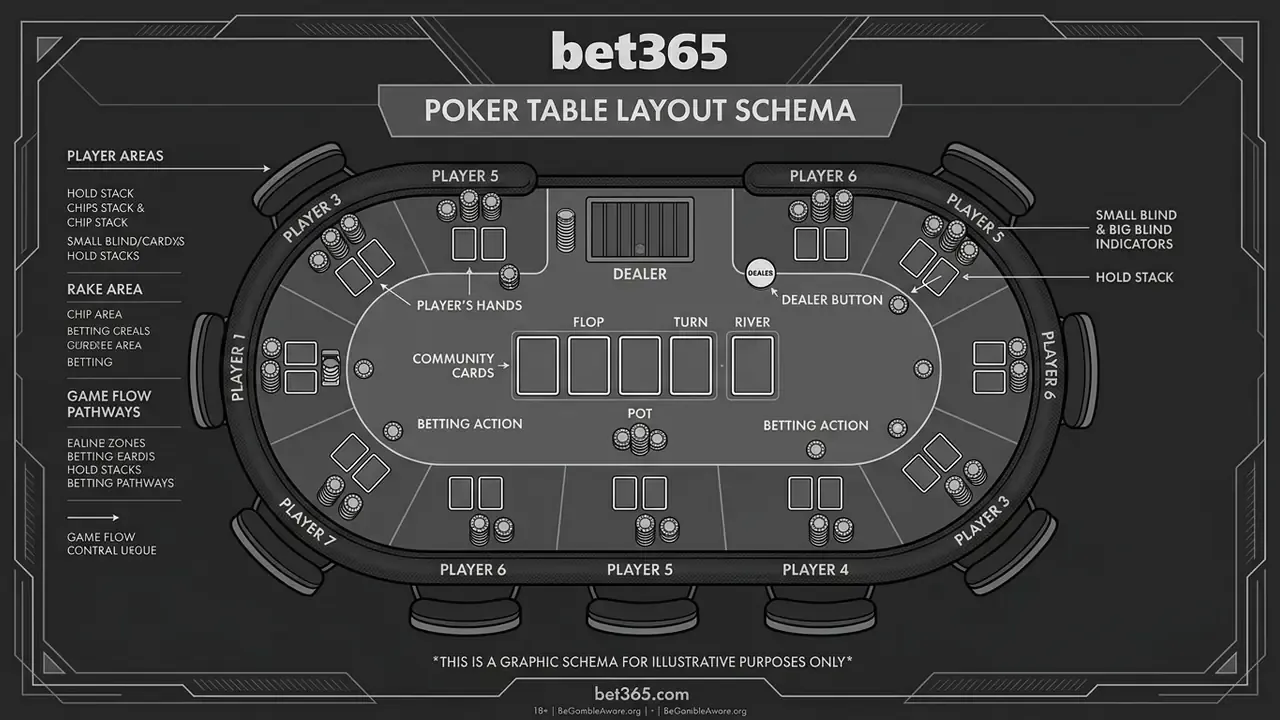
Table positions revolve around the dealer button, which decides who receives cards first and who acts last during the betting progression. Acting last provides a massive strategic advantage because you observe opponent choices before deploying your chips.
The dealer role rotates clockwise after every single round, shifting the positional advantage consistently across all players. Cards are distributed in this same clockwise rotation. Player seats heavily influence the action flow. The individuals named the "small blind" and "big blind" sit immediately to the left of the dealer and must post forced bets. The "button" and "cutoff" positions act last post-flop, securing optimal information for decision-making.
"Players in late positions observe opponents' actions before making their own decision, forming the core informational advantage at the table." - PokerBench: A Benchmark for LLM Poker Reasoning (2024). arxiv.org/abs/2501.08328
Worth noting: many beginners underestimate how much position alone affects win rates. Even with identical cards, the player acting last has a measurable edge.
Poker Rules Every Beginner Should Know
Standard poker rules require players to act in a strict clockwise order, choosing whether to fold, check, bet, call, or raise. A hand is valid when formed accurately from the distributed private and shared cards across dedicated betting stages.
Familiarising yourself with the poker game rules prevents costly fundamental errors. The order of play ensures absolute fairness during betting sequences. To play poker online safely, understand when to deploy a fold (surrendering your cards and exiting the round), a check (passing the action without betting), or a raise (increasing the current stakes). These actions are executed during specific phases of card distribution, creating the mechanical core of playing poker safely, as defined by the World Series of Poker Official Rules (WSOP, 2023) and the Poker Tournament Directors Association (PTDA, 2024).
Blinds, Bet and Betting Order
Blinds are forced bets made by two players left of the dealer before any cards are dealt. They seed the initial poker pot. The small blind and the big blind dictate the game's stakes and establish the minimum bet limits for the table.
Usually, the small blind equals half of the table's minimum unit, while the big blind covers one full betting unit. This initial bet order forms an obligatory pot that incentivises players to join the action. The betting sequence around the table forces players to match the big blind, raise it, or fold prior to seeing any community cards. Each subsequent bet affects the pot size, directly escalating the financial risk. International Poker Federation, Standardised Poker Guidelines, 2024.
A quick example: at a ₹5/₹10 table, the small blind posts ₹5 and the big blind posts ₹10. Every other player must at least match that ₹10 to see the flop.

What Players Receive: Hole Cards and Community Cards
Players receive private hole cards face down, and later share community cards dealt face up in the centre of the board. In popular formats, you combine your hidden hole cards with the visible community cards to construct your final five-card hand.
The fundamental difference between hole cards and community cards lies in information asymmetry. Hole cards are completely secret, known solely to the player holding them. Community cards are revealed progressively over three distinct stages, forcing players to use all available cards to deduce probable winning combinations. This dual-card model ensures that the mathematics of betting shift as new public information alters the strength of private holdings. As David Sklansky explains in The Theory of Poker: every time you play a hand differently from the way you would if you could see your opponents' cards, they gain, and every time you play a hand the same way you would have played it if you could see their cards, they lose.
Poker Hand Rankings from High Card to Full House and Flush
Poker hand rankings determine the winner at showdown, classifying hands strictly from the weakest high card format to the dominant royal flush. Combinations like a full house or a flush will reliably defeat standard pairs or straight cards.
Every single variation of playing online poker uses this specific hand hierarchy. The rules are rigidly defined by combinatorial probabilities: the rarest sets rank the highest. Cards are mathematically compared, meaning a flush consisting of five cards of the same suit beats a straight. Important note: suits (hearts, diamonds, clubs, spades) carry no ranking value over one another. Two flushes are compared only by card ranks, not by suit colour.
How Poker Hands Are Compared
Poker hands are compared by checking the primary combination first, then using secondary card numbers, known as kickers, to break any ties. If players hold identical top combinations and kickers at the showdown, the pot is split equally.
The ranking priority dictates that the best five cards out of the seven available create the final verdict. Tie situations arise frequently. When comparing a pair against another pair, the highest matching card wins. If the pairs remain tied, the highest unmatched card determines the outcome.
| Rank | Hand type | Brief description | Example |
|---|---|---|---|
| 1 | Royal Flush | A, K, Q, J, 10 of the same suit. | 10♠ J♠ Q♠ K♠ A♠ |
| 2 | Straight Flush | Any five cards in sequence of the same suit. | 5♥ 6♥ 7♥ 8♥ 9♥ |
| 3 | Four of a Kind | Four cards of the same rank plus an unrelated fifth card. | Q♣ Q♦ Q♥ Q♠ 2♠ |
| 4 | Full House | Three cards of one rank and two cards of another rank. | 8♠ 8♦ 8♥ K♣ K♦ |
| 5 | Flush | Any five cards of the same suit, not in sequence. | 2♣ 5♣ 7♣ 9♣ J♣ |
| 6 | Straight | Any five cards in numerical sequence, not all of the same suit. | 3♦ 4♠ 5♥ 6♣ 7♦ |
| 7 | Three of a Kind | Three cards of the same rank plus two unrelated cards. | 7♠ 7♦ 7♥ 2♣ 9♠ |
| 8 | Two Pair | Two different pairs plus one unrelated card. | J♠ J♦ 4♣ 4♥ 8♠ |
| 9 | One Pair | Two cards of the same rank plus three unrelated cards. | A♠ A♦ 3♣ 5♥ 9♠ |
| 10 | High Card | Any five cards that do not form any combination above. | K♠ 4♦ 7♥ 2♣ 9♠ |
How a Standard Poker Round Goes Step by Step
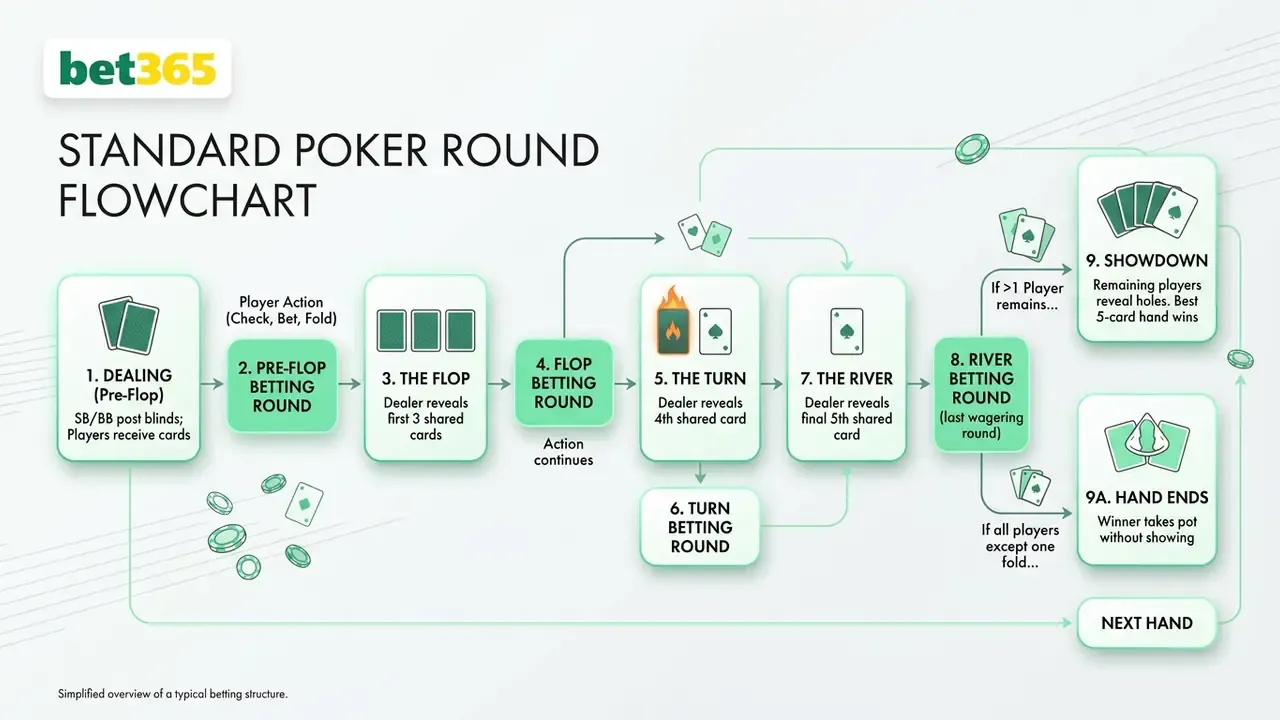
A standard poker round unfolds through four distinct betting stages known as pre-flop, flop, turn and river, culminating in a final showdown if multiple players remain. Every stage allows players to increase stakes, match existing bets or fold their cards.
Understanding the round structure prevents you from making irrational out-of-turn actions. The sequence of betting directly connects to the sequential revealing of community cards. After every player receives their hidden hole cards, poker proceeds through a structured timeline of decisions.
"A hand of poker is an iteration of four betting rounds in which the player wins or loses the pot of chips." - PokerBench: A Benchmark for LLM Poker Reasoning (2024). arxiv.org/abs/2501.08328

Pre-flop: First Decisions After Receiving Cards
The pre-flop round is your initial betting phase, happening immediately after you receive your hole cards but before community cards appear. The player seated in the under-the-gun position moves first, evaluating their hand strength against their table seat.
During this stage, your first decisions are based exclusively on private information. Position impact is massive here: acting early means you have no data on how opponents will behave, making it critical to play only premium cards from early seats. The first betting choices revolve around entering the pot by either completing the big blind amount or escalating the stakes to isolate competitors.
"Pre-flop abstraction methods reduce exploitability by more than 80% compared to basic equity-based approaches." - WEVA: Weighted Equity and Value Abstraction for No-Limit Texas Hold'em (2024). arxiv.org/abs/2406.15347
Here is a small observation from reviewing beginner hand histories: the single most common pre-flop mistake is playing too many hands from early position. Tightening your range from those seats alone can cut early losses dramatically.
Flop, Turn and River with Community Cards
The board cards are revealed progressively: three on the flop, one on the turn, and a final one on the river. Each new card triggers a fresh betting circle, fundamentally shifting the math and potential of your current poker hands.
How community cards appear by stages creates distinct sub-games. The flop instantly defines the texture of the board, allowing you to gauge whether a flush draw or straight connection is viable. Repeated betting rounds activate after each reveal, starting from the first remaining player located left of the dealer. As the turn and river emerge, hand strengths solidify, altering the aggression factors at the table considerably.
"The Student of Games algorithm applies game-theoretic reasoning to each post-flop sub-game, adapting to changing information sets in real time." - Schmid, M. et al., "Student of Games," DeepMind (2023). arxiv.org/abs/2112.03178
Showdown and How the Winner Is Decided
The showdown is the final step where the last remaining active players reveal their cards to identify the highest poker hand. A pot is awarded without a showdown if everyone else folds to an aggressive bet on any previous street.
During the final comparison of hands, the player holding the best five cards mathematically claims the winnings. The last aggressor must usually reveal their cards first. If all opponents fold before the river is dealt, no cards need to be shown and the last active player wins by default. WSOP Official Rules, 2024.

Main Poker Games and How They Differ
The main poker games differ primarily in how cards are distributed to players, splitting into shared community-card formats and fully private-card formats. Texas Hold'em dominates online structures, while five-card poker remains the classic hidden-card variation.
For Indian users searching for clear casino information, understanding these format differences prevents unexpected rule friction. The common card poker formats found internationally possess varying rules regarding betting layers and drawn replacements. You should verify which poker games are most common online before making your initial deposit. Explore online poker on trusted platforms to compare available variants.

Texas Hold'em and Community Cards
Texas Hold'em is the industry standard because it tightly balances private information with visible community cards, creating a highly strategic game environment. It features in the vast majority of online poker rooms globally and remains the headline event at the World Series of Poker.
Hold'em's popularity rests on its 52-card deck, which ensures that the strongest combinations are mathematically constrained. This creates a predictable hand-distribution curve where skill dominates over luck in the long run. WSOP Official Methodology, 2023. The basic structure relies completely on the blend of hole cards plus community cards, enabling intense analytical decisions across four betting rounds.
"Researchers at the University of Alberta computed a strategy for heads-up limit Hold'em with an exploitability of less than 0.001 big blinds per hand." - Bowling, M. et al., "Heads-up Limit Hold'em Poker is Solved," Science (2015). science.org/doi/10.1126/science.1259433

Five-Card Poker and Other Classic Formats
Five-card poker relies completely on concealed private cards alongside a dedicated drawing phase where you actively swap out weak hands. Because there are no community cards used at all, the game pace differs entirely from community-card variants.
In this classic iteration, your strength assessment hinges solely on how many replacements opponents request. The pace and complexity differences mandate totally separate bankroll strategies compared to modern online dominant formats. Knowing where classic variants fit among all poker games expands your foundational grasp of betting systems. Gambler's Book Club, Five Card Draw Rules, 2022.

Pot Limit Omaha (PLO): The Second Most Popular Online Format
Omaha plays similarly to Hold'em but deals four private cards instead of two. The critical rule difference: a player must use exactly two of their four hole cards combined with exactly three community cards to form the best five-card hand. This creates far more possible combinations and higher variance.
Pot Limit Omaha is the second most-played format in international online rooms. Because the maximum raise is capped at the current pot size, the game produces escalating pots without the instant all-in risk of No Limit. If you enjoy complex hand reading and post-flop strategy, PLO is a natural next step after mastering Hold'em fundamentals.
Limit, Pot Limit and No Limit Betting Formats
Betting formats dictate your core financial exposure: fixed limit completely caps your bets at predetermined scales, pot limit sets maximum raises against the total present pot, and no limit betting permits risking your entire bankroll instantly. The chosen format severely impacts your bet-sizing constraints.
These structures generate totally different mathematical and emotional volatility profiles:
| Format | Maximum raise | Volatility | Best for |
|---|---|---|---|
| Fixed Limit | Equal to the predetermined bet size for that round | Low: losses per hand capped at 2 big bets | Beginners learning hand values |
| Pot Limit | Equal to the current pot before the raise | Medium: pots grow progressively | Players comfortable with post-flop math |
| No Limit | Up to the player's entire remaining stack | High: one mistake can cost your entire bankroll | Experienced players with bankroll management |
Which Betting Structure Is Easier for New Players
A fixed structure is substantially easier for new players because it restricts the maximum financial loss per hand, safely protecting your bankroll from single catastrophic miscalculations. No limit formats quickly penalise rudimentary mistakes with immediate elimination.
The relative simplicity of fixed structures allows you to properly learn hand categorisations without the stress of navigating massive all-in wagers. Proper risk control is built into the strict bet-sizing boundaries.
PokerStrategy's Fixed Limit Guide (2024) explicitly recommends the format for beginners, noting that the maximum loss per hand is capped at two big bets, preventing rapid bankruptcy from a single error. - PokerStrategy, "Fixed Limit Poker Guide for Beginners," 2024.
Honestly, I would go further: if you are brand new, spend your first 1,000 hands in fixed limit before even considering pot limit or no limit. The discipline transfers well.
How to Play Poker Online and Access the Offer
To play poker online effectively, participants navigate cross-platform clients, register securely and select table limits specifically matching their budgets. Securing access requires confirming localised features like UPI or INR compatibility before accepting any new-player offer.
The online poker entry path necessitates strict attention to the verification timeline.
"Players often complain about stuck withdrawals after completely ignoring trust checks. During an intensive compliance audit for an operator, we observed that explicitly highlighting KYC requirements pre-deposit reduced payment friction entirely. Check these exact parameters before downloading an app." - Nisha Rao, Casino and Betting India
Access conditions alter the safety of your preliminary session substantially.

What to Check Before Choosing Poker Sites
Before depositing on poker sites, use this practical checklist:
- Regulatory licence -verify authenticity on the issuing regulator's public registry (e.g., Malta Gaming Authority, Curacao eGaming).
- Active player traffic -solid traffic volumes signify that the operator pays out winners reliably and fields functional customer support.
- RNG certification -an independent lab such as Gaming Laboratories International (GLI) or eCOGRA should have audited the random-number generator.
- Micro-limits -tables at stakes as low as ₹1/₹2 or $0.01/$0.02 let beginners learn without heavy risk.
- Rakeback and commission transparency -ensure the platform clearly states its rake percentage and any rakeback programme (top sites offer 25-50% rakeback to sustain your bankroll).
- Anti-collusion policies -the site should actively detect and penalise collusion (two or more players secretly cooperating at the same table).
- Payment methods -Indian players should confirm UPI, PayTM and bank-transfer availability, plus check processing times for withdrawals.
"Regulators require licensed operators to conduct RNG audits, segregate player funds and provide responsible-gambling tools." - Pennsylvania Online Gambling Report (2024). ddap.pa.gov
"Median total player expenditure over two years was €439.70 across a median of 43 sessions per player." - Auer, M. & Griffiths, M., "Second session at the virtual poker table," Journal of Gambling Studies (2022). doi.org/10.1007/s10899-021-10062-5
Free Play, Real Money and What the Offer Can Include
Disclaimer: Online poker for real money is a form of gambling and may be restricted or prohibited in your jurisdiction. The information below is general in nature and does not replace professional advice. Always check local laws before depositing.
Free-play modes grant worthless virtual chips intended solely for risk-free learning, whereas real-money poker demands verified financial deposits carrying genuine gambling risks. A welcome offer can include varied incentives that strictly rely upon intense wagering conditions.
The difference between free and money platforms extends beyond the financial surface. Psychological adjustments heavily alter opponent behaviour when real money is at risk. What new players usually look for in an offer frequently triggers false confidence if terms remain unread. For instance, a "100% deposit match" sounds generous until you discover it requires clearing 20x the bonus amount in rake before any withdrawal is possible.
"Players who have recently placed bets are at higher risk of developing gambling problems regardless of the format." - Bjerg, O. et al., "Perceived riskiness and problem gambling across different forms of gambling," Journal of Gambling Studies (2024). doi.org/10.1007/s10899-024-10289-2
Is Online Poker Legal in India?
The legal status of online poker in India depends on the distinction between games of skill and games of chance. Several Indian High Courts, including the Karnataka High Court (2021) and the Calcutta High Court, have recognised poker as a game predominantly of skill. However, some states such as Andhra Pradesh, Telangana, Tamil Nadu and Assam have passed specific laws restricting or banning online real-money gaming, including poker.
Key points for Indian players:
- Skill vs. Chance:Under the Public Gambling Act, 1867, games of skill are generally exempt from anti-gambling laws. Poker's skill classification varies by state.
- Tax on winnings (TDS):Under Indian Income Tax law, online gaming winnings above ₹10,000 in a financial year attract a 30% TDS deduction at source. Platforms operating legally in India are required to deduct this before paying out.
- State-level bans:Always verify whether your specific state currently permits real-money online poker. Laws change frequently, and what was allowed last year may not be allowed now.
- International sites:Many Indian players use internationally licensed poker rooms that are not regulated by Indian authorities. While this is common practice, the legal grey area means players should proceed with awareness.
Disclaimer: This section is for informational purposes only and does not constitute legal advice. Consult a qualified legal professional regarding the current gambling laws in your state before playing real-money poker online.
Top Online Poker Sites for Indian Players
If you are ready to move from theory to practice, choosing the right poker room is your first real decision. Below is an overview of the types of platforms popular among Indian players, along with the features to prioritise.
What to Look for in a Poker Room
| Feature | Why it matters |
|---|---|
| Welcome bonus | Most rooms offer 100-200% deposit match; check wagering requirements carefully. |
| Rakeback programme | Returns a percentage of rake (commission) to your account. Top sites offer 25-50%. |
| Crypto deposits | Bitcoin, USDT and ETH deposits offer faster processing and lower fees at some rooms. |
| Freeroll schedule | Daily freerolls let you build a bankroll from zero, which is essential for beginners. |
| Mobile app quality | Look for native Android/iOS apps with vertical-table support for convenient mobile play. |
| Traffic volume | Higher traffic means shorter wait times and softer competition at micro-limits. |

Pros and Cons of Common Platform Types
International crypto-friendly rooms:
- Fast deposits and withdrawals, strong privacy, global player pools.
- Crypto has a learning curve; regulatory status in India can be uncertain.
Established global networks (e.g., WPN, GGPoker Network):
- Large tournament schedules, high traffic, proven track records.
- Bonuses may release slowly; some networks restrict Indian payment methods.
India-focused platforms:
- INR support, UPI and PayTM, localised customer support, built-in TDS compliance.
- Smaller player pools, fewer high-stakes options.
Compare specific rooms, their bonus conditions and payment options on Casino to find the best fit for your budget and playing style.
Best Ways to Start Playing Poker for Beginners
The best way to start playing poker centres heavily around joining single-table freeroll events to practise card-reading mechanics actively without jeopardising an actual budget. Concentrating on structured limits produces fewer compounding mistakes.
Your first practical steps require shutting down unnecessary distractions. Learning through simple formats ensures that you properly understand the basic baseline metrics before moving onward. A strict focus on rules and pure hand recognition constructs the fundamental logic used by actual elite-tier poker players progressing methodically.
"Elite professionals evaluate decision quality by expected value, not realised results, and avoid games outside their 'circle of competence.'" - Palomaki, J. et al., "Elite professional online poker players: A qualitative study," Journal of Gambling Studies (2023). doi.org/10.1007/s10899-022-10159-5
Start with Simple Rules and Common Poker Games
Begin your foundational journey by memorising pure hand rankings cleanly and strictly operating fixed-limit Texas Hold'em. Choosing familiar formats establishes a competent baseline safety net for developing analytical procedures and choosing a reliable poker platform.
Learning hand rankings first eliminates panic during betting sequences. Using simpler betting structures heavily reduces massive variance errors before eventually transitioning to faster unstructured games. Establish personal budget-loss limits explicitly, treating the entire process strictly as measured entertainment, never as income.
Practical beginner checklist:
- Memorise the hand-rankings table above. Print it or keep it open on a second screen.
- Play one table only (no multi-tabling) during your first 500 hands.
- Start with freerolls or the lowest available micro-limits (₹1/₹2).
- Use a pre-made starting-hand chart (tight-aggressive, approximately 15% of hands) and follow it strictly.
- Set a session loss limit (e.g., 20 big blinds) and stop when you reach it.
- After each session, review at least three hands where you were uncertain. This is how real improvement happens.
Responsible Gambling: Set Limits Before You Play
This part is not optional. Poker can be absorbing, and the line between entertainment and compulsion is thinner than most players admit.
Before your first real-money session, set three hard boundaries: a deposit limit for the month, a session time limit, and a loss limit per sitting. Most reputable poker rooms offer built-in tools for all three. Use them. If you find yourself chasing losses, increasing stakes to "win it back," or playing longer than planned repeatedly, those are warning signs.
Resources for Indian players:
- iGamCare provides free counselling and support for gambling-related issues.
- Most licensed platforms include self-exclusion options in account settings.
- The National Commission for Protection of Child Rights (NCPCR) has flagged underage access to real-money gaming; verify age restrictions are enforced on any platform you use.
Gambling should remain paid entertainment with a clear stop point. If it stops feeling like entertainment, stop playing.
FAQ About Poker Online and Basic Gameplay
Beginners frequently carry critical questions about average game durations, mobile availability, and the complicated mathematical balance regulating decisions. Modern interfaces fully support constant mobile play.
Getting clear answers simplifies the transition into digital card environments. The time required for individual rounds fluctuates depending on player volume and the betting-limit restrictions in place. What beginners must understand above all: establishing budgets remains mandatory regardless of platform access.
Is Poker Mostly Luck or Skill Over Time?
Short-term poker hands undeniably contain high variance and luck, but comprehensive analytical data confirms that superior decision-making dominates financial outcomes heavily over a longer timeline. Repeated play categorises winners through sheer expected-value calculations.
"Skill significantly affects individual results; players improve with experience, and less-skilled participants tend to exit the game." - Levitt, S. & Miles, T., "The dominance of skill in online poker," Journal of Economic Behavior & Organization (2023). doi.org/10.1016/j.jebo.2023.01.012
The critical difference between short-term outcomes and longer-term decision quality defines why elite professionals reliably demonstrate profit margins across extensive historical datasets. Active skill significantly impacts personal end results, with experienced players systematically exploiting mathematical edges to overcome short-run variance.
"Online poker players demonstrate higher physical anhedonia and elevated BAS-Drive compared to control groups." - Lorains, F. et al., "Impact of online poker gambling on behavioural and neurophysiological indices of decision-making," Addictive Behaviors (2024). doi.org/10.1016/j.addbeh.2024.107841
Disclaimer: Long-term poker results depend on many factors. Past performance does not guarantee future earnings. If you feel you may have a gambling problem, seek professional help.
What Is the Minimum Deposit to Start Playing?
Most online poker rooms accept initial deposits starting from $5-$10 (or the INR equivalent via UPI). Some India-focused platforms set the minimum as low as ₹100. Freeroll tournaments require zero deposit and are the safest entry point for complete beginners.
Do I Need to Pay Tax on Poker Winnings in India?
Yes. Under current Indian Income Tax provisions, net winnings from online gaming above ₹10,000 per financial year are subject to 30% TDS. Legitimate platforms operating in India deduct this automatically before payout. Keep records of all deposits, withdrawals and game-play statements for your annual tax filing.
Can I Play Online Poker on My Phone?
Absolutely. All major poker rooms in 2026 offer native Android and iOS apps, many with vertical-table layouts designed for one-handed mobile play. Ensure your internet connection is stable. Disconnections mid-hand can cost you the pot, and that is a frustrating way to lose chips.
How Long Does a Typical Poker Hand Last?
A single hand of online Texas Hold'em typically takes 30-90 seconds, depending on the number of players and the betting format. Tournament hands may take longer due to larger fields. Fast-fold formats (sometimes called Zoom or Blitz poker) reduce the wait to under 15 seconds per hand by moving you to a new table as soon as you fold.
Ready to start? Compare poker rooms available to Indian players, check table limits and bonus conditions on Casino, and take your first step with clear rules and a controlled budget.
Last updated: 2026. This guide is maintained by the editorial team at Casino and Betting India. All facts are cross-referenced with official rules from WSOP, the Poker Tournament Directors Association and peer-reviewed research. For questions or corrections, contact the editorial team.